
eNovDay 2025: Moving HR from Administrative Support to Business Architect
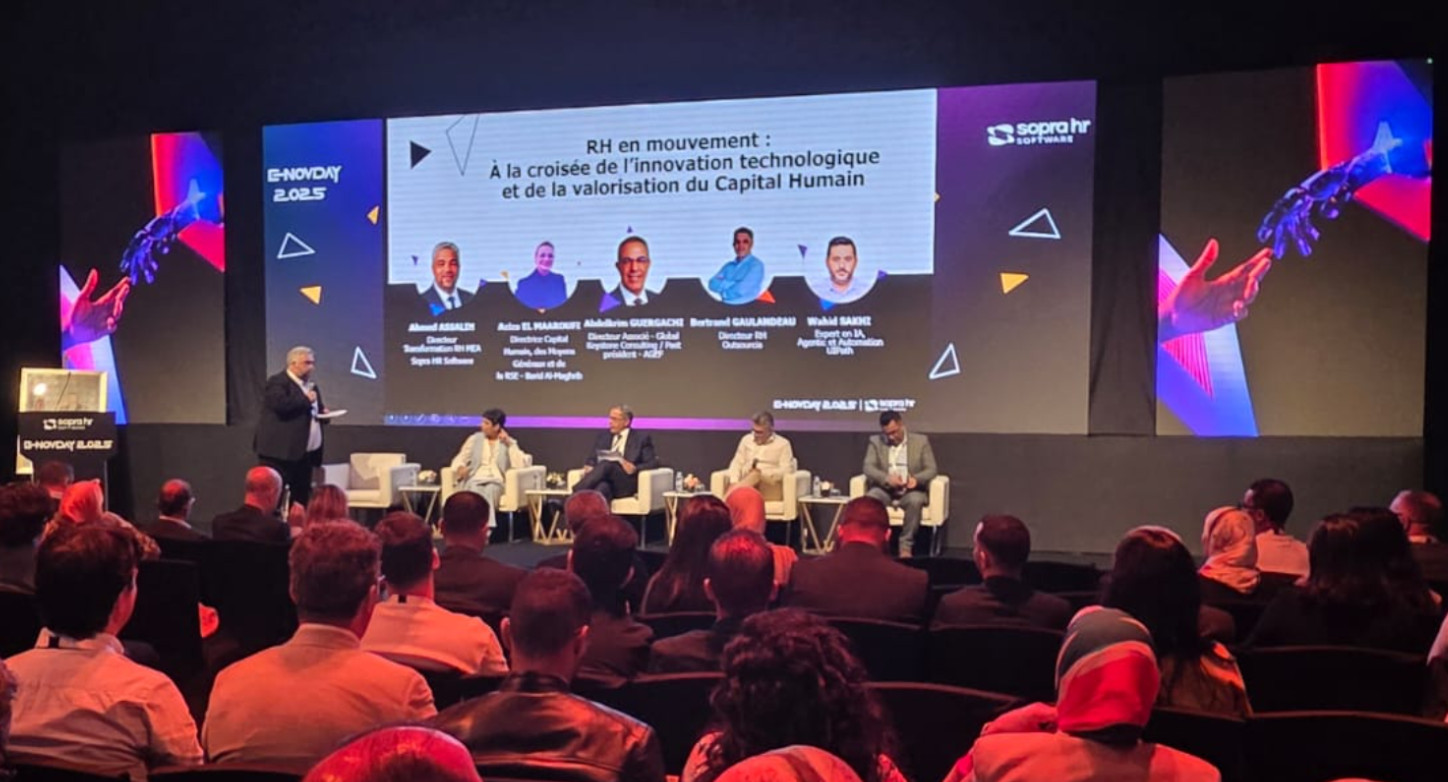
The success of eNovDay 2025 signals a maturity shift in the Moroccan market. Seeing the HR community gathered in Casablanca, it became evident that we have moved past the phase of “digital awareness” into the phase of “strategic requirement.” The energy in the room was not just enthusiasm; it was a demand for concrete solutions to complex structural problems.
My role in moderating the flagship panel, “HR in Motion,” was to steer the conversation away from polite consensus and toward the operational friction points that stifle transformation. I challenged my panelists—Abdelkerim Guergachi, El Maaroufi Aziza, Bertrand Gaulandeau, and Wahid SAKHI—to peel back the layers of their daily reality.
The exchanges were revealing. When I pressed Abdelkerim Guergachi on the concept of agility, he rightly argued that agility is often blocked not by technology, but by rigid organizational mindsets. He highlighted that an HRIS is useless if the culture doesn’t support decentralized decision-making. El Maaroufi Aziza countered with the operational reality, detailing the difficulty of maintaining “Business as Usual” while deploying disruptive innovation. Her insights on the gap between boardroom strategy and field adoption were particularly sharp.
Bertrand Gaulandeau elevated the debate to the international standard, emphasizing that in a globalized talent market, our local systems must align with global data taxonomies to remain competitive. Finally, Wahid SAKHI brought the necessary technical grounding to the discussion. We debated the integration of AI, where he stressed that AI is not a magic wand but a calculation engine that requires pristine data governance to function.
The conclusion of our debate was unambiguous: The era of HR as a support function is over. We are entering the era of HR as a Business Architect. The “Motion” we discussed is the transition from managing administrative complexity to engineering value creation.
At Sopra HR Software, this is precisely where we position our value proposition. We do not just sell software; we secure the trajectory of this transformation. The insights shared by my panelists confirm that AI is the strategic lever for 2025, but only for those who are ready to structure their data and modernize their legacy architectures. For the leaders present, the time for observation has passed. We must now move into execution mode.